

This song singlehandedly talked me into buying all of her records. John and Joey from Calexico were the nucleus of the backing band, giving the familiar folk-rock elements startling and surprising turns. Every phrase in this song sets a scene and tells a story, and no one but her could sing them. Pitchfork interviewed her in 2006 and she had a thing or two to say about the lyrics.
Train Crossing Desert near Kelso, California, by one William Garnett.
“Anyway, it is tragic but interesting to contemplate how transplanting living cultures into the soil of modernity so often results in the culture and its people withering and dying. Why is that? I don’t think there is a material explanation for it, at least not one that is satisfactory.”
Rod Dreher, in the comments to this brief Front Porch Republic post.
Given the aridity of modernity, the way it manifestly does not care for humanity—whether individuals or congregations of people—how does it consistently win out over traditional cultures? What about it is appealing or powerful enough that people let it erode the cultural soil that sustained them for so long?
Is it that the razzle-dazzle of stuff and “freedom” and all the other crap modernity pitches is superior to the old ways—that is, when those old ways have become fossilized by a generation or two that never understood them to begin with? When the older generation no longer believes what was promised and no longer lives as if those promises were ever true…
If that’s the case, how about this: I think we are in that fossilization phase with modernity, whose promises remain unfulfilled and have been found out as utterly false.
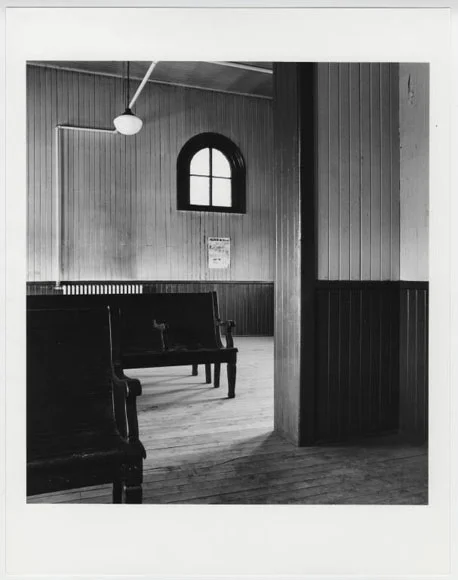
Waiting Room, former Chicago & Eastern Illinois Railroad, 1966. David Plowden.
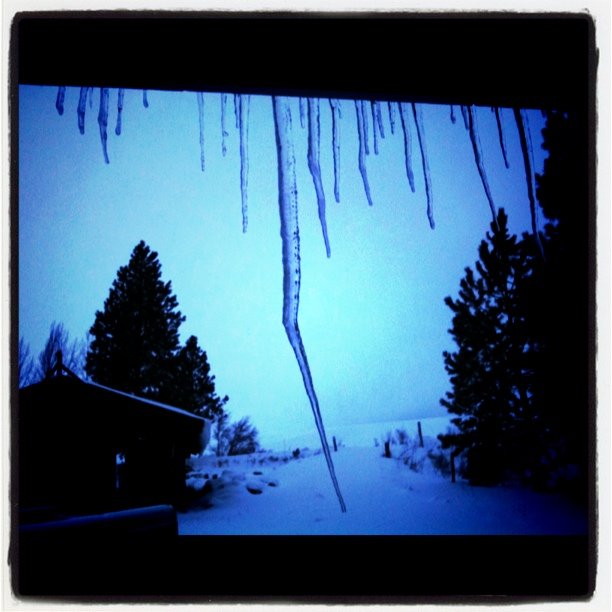
Wind-bent icicles.
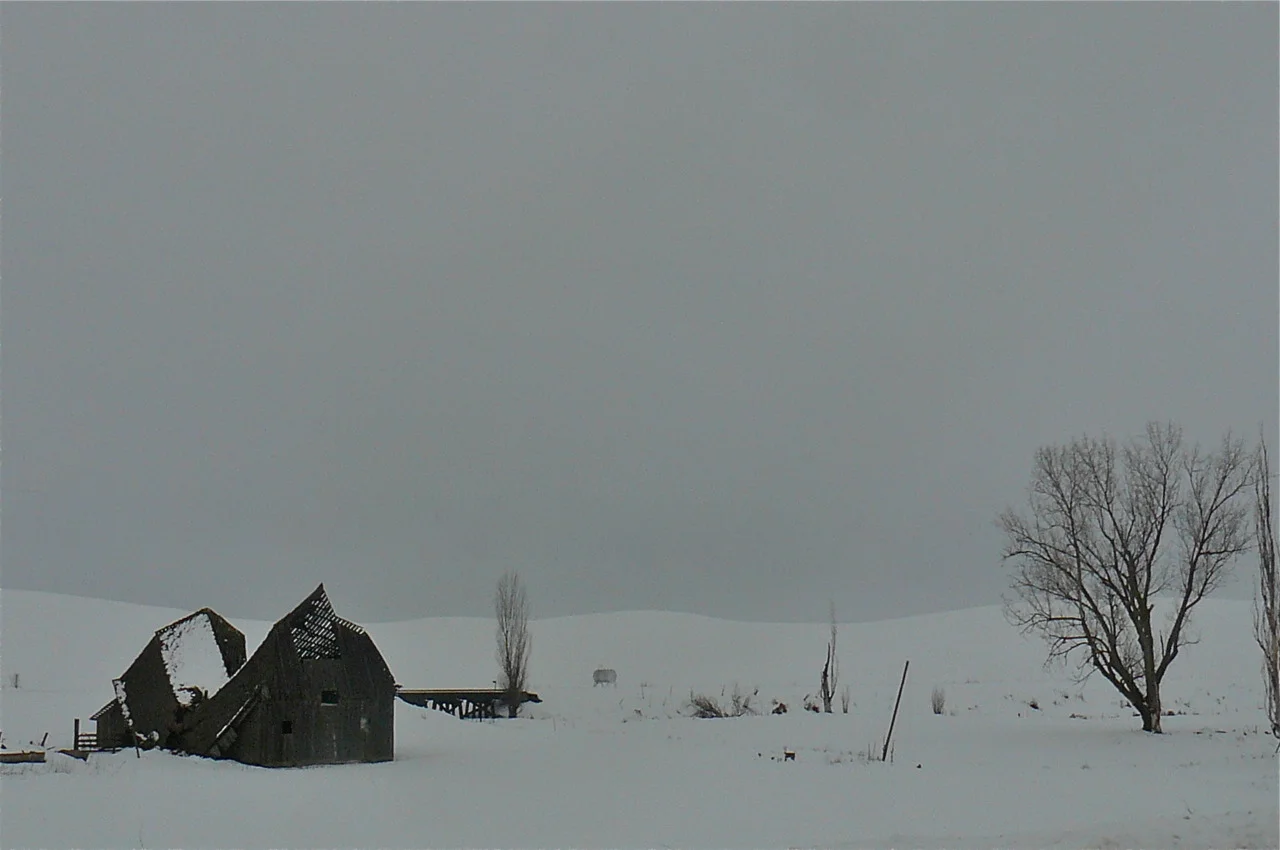
Tomer Butte, lenticular cloud, fireball sun.
“When my family and I raised chickens on our farm in Henry County we realized a net profit of $6,000 on the sale of 2,000 chickens processed over the course of five months. A factory farm realizes a profit of $20,000 to $30,000 on the sale of 1,200,000 chickens.
…
The grain farm and the hog and chicken farm are the result of a modern industrial mind, a mind that refuses to accept any context.”
From “Agriculture vs. Agribusiness”, by Wendell’s daughter Mary Berry Smith, on Front Porch Republic.
The Berry family made a profit of $3 per chicken. The factory farm made a profit of—assuming the $30,000 number—two and a half cents per chicken.
Last summer, I went in halfsies on an 800-bird chicken business. After all the capital outlays (chicken housing, feed, a plucker, other assorted items), a loss of over 100 chickens to some hard Spring weather, the diversion of another 120-150 chickens to our own freezers, we still made a wildly better per-bird profit (spread out over the 800 birds, not the 550+ that we sold) than the industrial chicken operation.
“Words are polluted. Plots are polluted. In the best movie of last year, a disturbed young man played by Timothy Hutton consults a psychiatrist a couple of times, breaks down, hugs the psychiatrist, says “I love you,” and is cured. He also has a communication problem with his father. They both break down, hug, cry, say “I love you.” All is well. Lines of communication are opened. Love is the answer. Who is going to protect words like “love,” guard against their devaluation?…There may be times when the greatest service a novelist can do his fellow man is to follow General Patton’s injunction: Attack, attack, attack. Attack the fake in the name of the real.”
The Soul of the Parish is Making →
Written by one Fr. Andrew O'Connor of the Bronx, New York. Because this page is a horribly-designed semi-iframe content wrapper piece of junk, I’ve taken the liberty of copying it to this page here. A lot of people are talking this way nowadays—getting back to local, sustainable economies; fostering community and charity by making stuff; recovering a crucial part of our humanity by working with our bodies. But only Christianity—in its denial of self and its teleology of uniting soul and body, heaven and earth, God and man—actually has the weight to ballast this sort of endeavor. I might niggle with one or two things O'Connor has written here, but altogether, I’m really digging this.
Some American parishes dabble in T-shirts and cause-related goods, but this is more of a reflection of affluence and leisure than necessity. These ventures are not brave enough. We need to begin living in a new way tapping into our ancient beliefs and practices: making something out of little or nothing, building sacred dependency on one another, imbuing the ordinary desiderata of life with intelligence and the savor of love.
Doug Paisley on Daytrotter →
A really excellent Daytrotter session. This fellow has a record I’m curious about now.

Three beaners waiting for the grain train near Oakesdale in January.
Sam Beam's Tiny Desk Concert
Sam Beam’s songs sound a lot better in this stripped-down form. A friend of mine said that Beam is probably this generation’s Dave Matthews. From what I’ve heard of the new record, he’s certainly in danger of that. Some singers need to add more to their songs, but Beam’s songs just don’t do well when weighed down beneath layers of studio. I’m looking at you Shepherd’s Dog, and I’m glowering at you, new record out tomorrow. I’m no encase-it-in-amber purist; I like it when songwriters stretch their sound. But Beam hasn’t taken his music in a very interesting or necessary direction, nor has the sound he’s alighted upon done his otherwise precise songs any justice.
As a side note, his brief asides in between songs concerning songwriting are worth listening to; they underscore his care as a writer and how needlessly overproduced his records are getting to be.
I believe that the records that played in the background when you were a kid determine, to a large extent, the kind of music you’ll listen to when you’re an adult. Even those who react against what they were raised with (lots of my buddies had to listen to some pretty horrid “Christian” music in their nonage), I think, are still drawn to music that sounds similar on some level. I won’t take any more time defending this thesis; I’ll just say that I’ve observed this at work in almost everyone I know.
Two recordings founded my own record collection. First, the cassette version of Neil Young’s Harvest b/w After the Gold Rush: from thence comes my taste in classic country, classic rock, country-rock, folk music—and so on. Second, Talking Heads’ Stop Making Sense. This album cultivated in me a taste for intelligent, danceable music and—despite it being a live record—the use of the recording studio as an instrument. One cassette or the other was always playing whenever my family would pile in for a car ride of any length. By the time I was 15, both were worn out completely and unceremoniously discarded in favor of the CD versions.
Save for the sacred and classical music weighing down my CD shelves and portions of iTunes (owed to Arvo Pärt’s Te Deum and years of singing in choirs), every record I own now is traceable to the imprint of those two records. There’s a secondary layer of massively-influential albums—Combat Rock, I Care Because You Do, Darkness on the Edge of Town—but they themselves clearly descend from my two primary sources.
It should be really obvious which record got me listening to LCD Soundsystem.
“In a society where the prevailing ideal is material gain and where physical labor is studiously avoided as wholly inadequate to the realization of that ideal, my reference to the dignity of human toil may invite the charge of sentimentalism. Let me anticipate the rebuke and hasten to explain that I do not mean primarily the kind of industrialized labor which is nothing more than enslavement to a machine, work that degrades the worker and saps his vitality. That kind of labor, common and unskilled, is basic in our economy. Those who do it for us should have our sympathy and understanding, as well as an adequate reward. But my reference is to toil of another kind, to physical labor that is modestly creative and independently productive; work that activates the bones and sinews and that at the end of the day, week, or month yields something for the worker to behold as entirely his own creation. Man needs such toil for the good of his body and mind as much as he needs good food and the passionate lyricism of a Mozart; and the more he divorces himself from it, the greater will be his estrangement from life and the millions of workers who toil in his behalf.”
“I’m not exactly a slow writer—when I’m really cooking I can do 800-1,000 good, polished words in two hours, that’s not bad—but it can take me a long time to get cooking, and sometimes one sentence can hang me up for an hour. (Those are usually the first sentences, in the next draft, to be cut. You would think I might have learned by now.) I have a hard time writing an excuse to one of my kid’s teachers, a recipe for Dutch babies, an apologetic email, without sinking into a revisionary funk. I’m also slow to know what I think, and slow to know how I feel: we’re talking reptile time, rock time, empires rising and then crumbling to dust. I still haven’t decided how I feel about Sandinista!, for example, and I’ve been thinking about it on and off since 1980.”
“Ellis was my grandfather, my father’s father, to be more precise. In some ways, I am writing the song through my own father’s eyes, trying to trace his own experience with his dad. My dad and I don’t get along all that well. He was a hard man to grow up with (“it takes pain to grow, don’t you know, don’t you know”), not someone you’d call exactly call a role model. I wanted to know what made him the way he was, why he had so much anger. When my grandfather died, my dad cried and acted like the world was half dead. I know for a fact that Ellis wasn’t kind to my father. So why was my dad in mourning? Blood is thicker than water, as they say (“The days are like blood, the nights are like wine”). We moved around a lot as a kid. My father was restless, and always running. Further and further away from his own family. The line, “What good is a man without a family, my son?” is my own imagining of what Ellis would say to my father as my dad kept putting more miles, more distance, between our extended family. It is also a reminder to me: Ellis is right. But what kind of family is he talking about? We can’t avoid blood (“I see his face sometimes, and it looks a lot like mine”). We can’t choose our parents. We can’t escape our past. But we can learn from it, and choose how we want our own families to be. His abuse doesn’t have to be mine, though “All of my children, they are carrying his name.” I don’t have children. In some ways, I am the child, and my children will carry his name. But they don’t have to carry the burden of Ellis’, nor my father’s, behavior.”
The Maldives are stupendous 8-man band from Seattle. They played at Birds on a Wire in March 2010, and it was all the theater could do to contain them; something I read about them somewhere described their sound as “Epic Americana”, which just about nails it. “Blood Relations” was one of the most visceral moments in the show—pure rock power that stirred everyone’s blood to move faster, singer Jason Dodson howling beautifully over the band’s astonishing four-axe attack. The song is about the shadow a father casts over his son and his son’s sons. Somebody somewhere is standing on his grave, but all of my children are carrying his name, goes the refrain. It’s a song for men; it gets at the ambivalence that grips us all, at some point, about our fathers. Sadly, most men who put this struggle in their work only wallow in it, never getting anywhere. But “Blood Relations”, I think, is the sound of a man fighting through it, grasping for the peace he knows that is to be had with his father’s shadow—no matter how elusive it may seem.
- Here’s the text of my interview with Dodson on its own page.
Buckner’s Since is my favorite record of his this week. “Ariel Ramirez” might be his most famous song (one friend says that no song better describes the hole at the center of that man) but “Faithful Shooter” is probably what really roped me in to the entire album. As always, it’s Buckner’s lyrics that really get at me; if poetry is a concentrated excess of language, they are poetry (even if the subject is ultimately rather maudlin…). These lines really struck me:
You looked up to her window from the backyard dusk/Hired as a shot, lingered as a crush
See I’ve only had a photograph to drag around
Would you take another trip with a candle like her/Strike another promise and watch it burn?
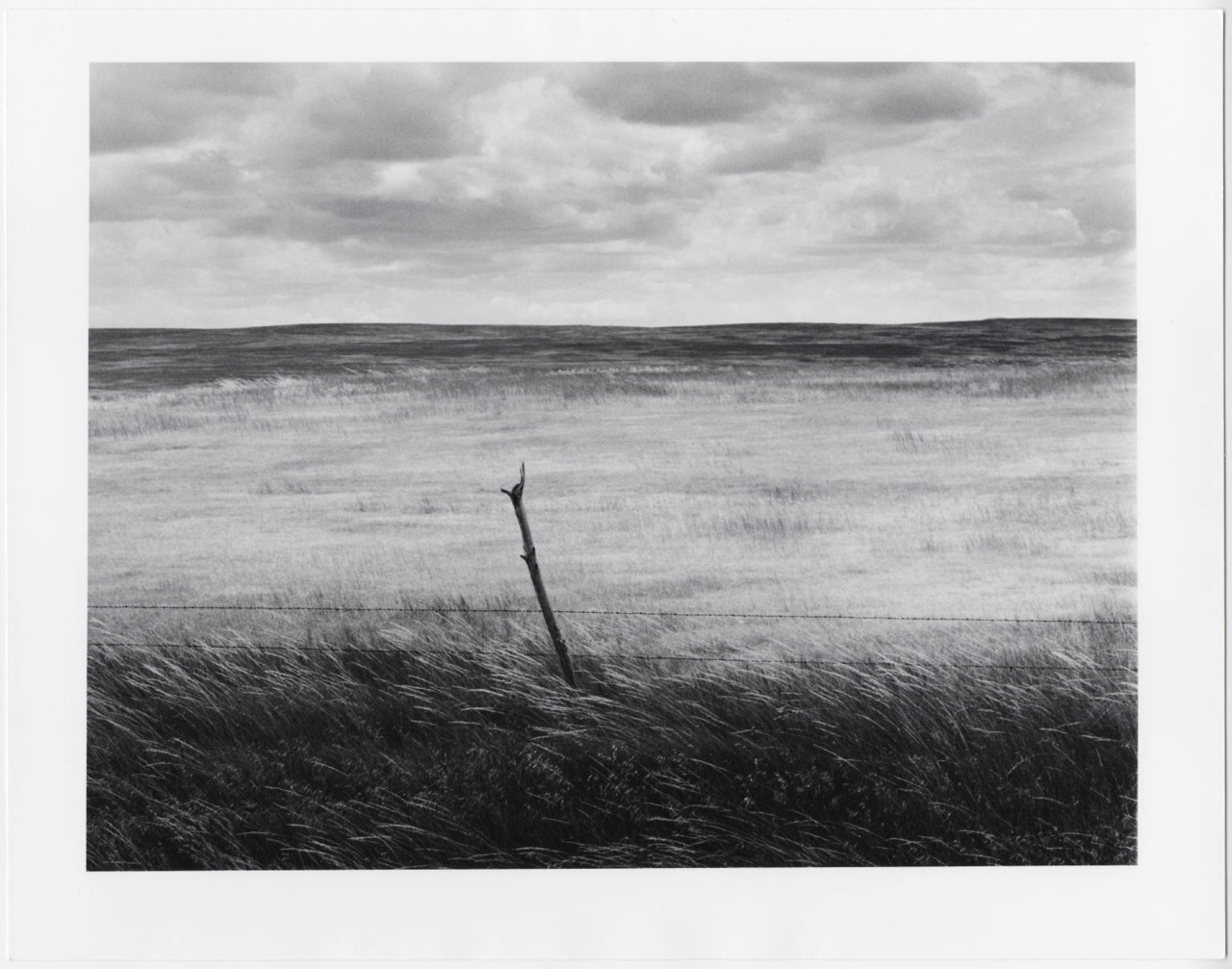
South Dakota. The light and wind and grass are beautiful, but it’s the two strands of barbed wire that make this picture. Found at the pretty comprehensive Plowden image collection at Yale University’s Beinecke Rare Book and Manuscript Library.