I was gonna post this as a quote, but the whole thing is one of the most riveting things I’ve read in awhile.
your monkey called: Q: How many Cormac McCarthies does it take to change a light bulb? →
A: Two or perhaps three, approaching now, from beyond the tree in the long low light of morning. From some black place: a reckoning neither required nor bidden, a reckoning no judge could have ordered, but a reckoning nonetheless. One of the men carries a single glove, ready to grip the hot,…
“It is a sufficient proof that we are not an essentially democratic state that we are always wondering what we shall do with the poor. If we were democrats, we should be wondering what the poor will do with us. With us the governing class is always saying to itself, ‘What laws shall we make?’ In a purely democratic state it would be always saying, ‘What laws can we obey?’”

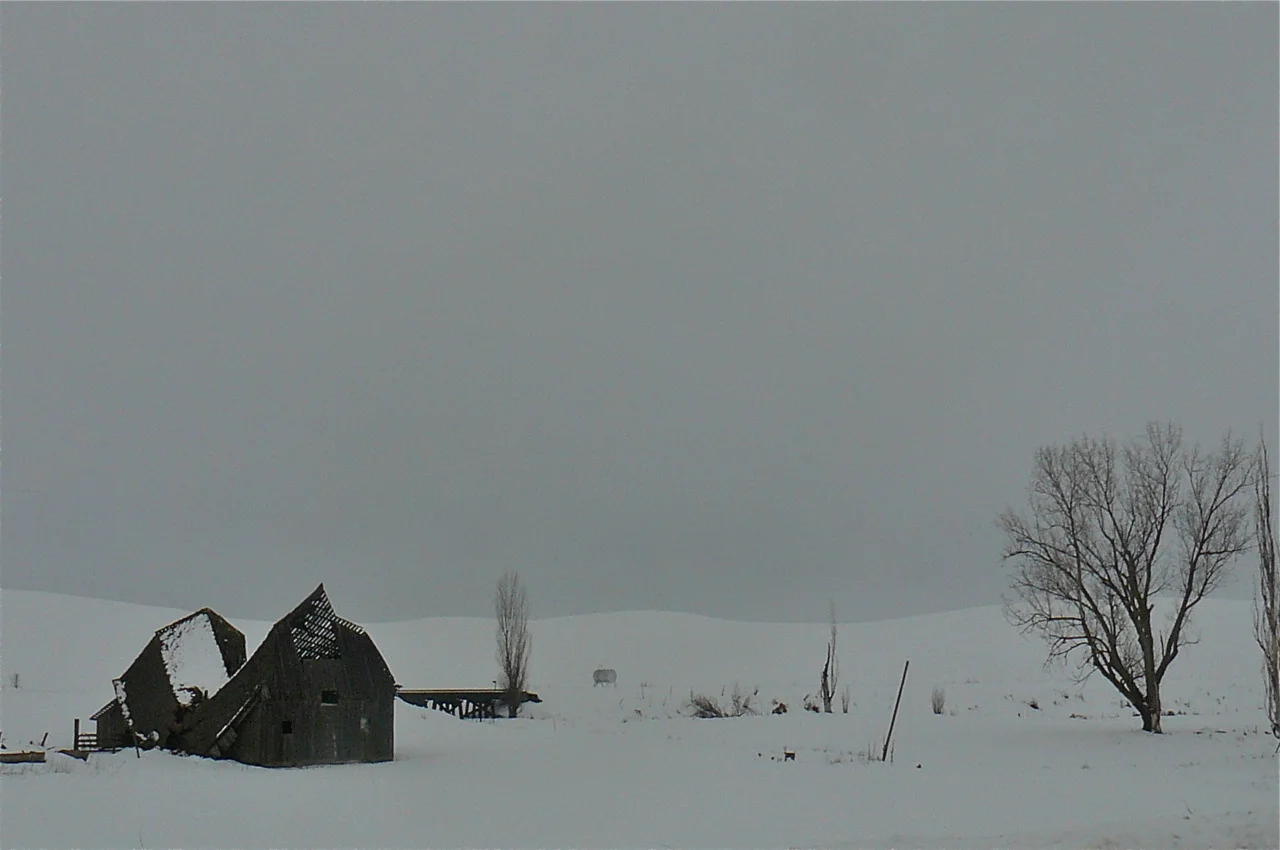
Storms are taller than mountains.

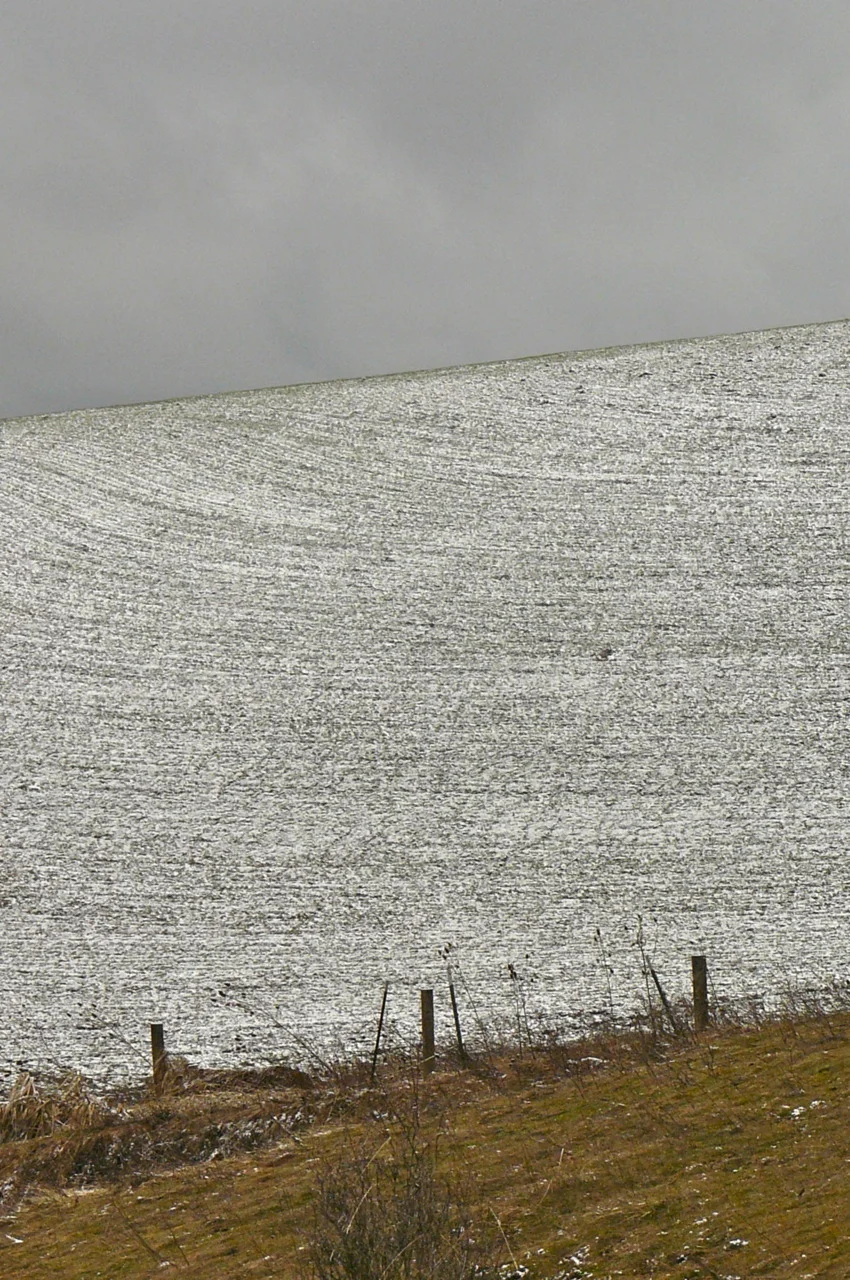
Closeup of snow-covered field.

Ponderosa
Filling up What is Lacking →
Peter Leithart in Credenda. This is, more or less, his Ash Wednesday homily. Theology needs to be terrifying and brilliant like this.

Cumulus clouds like that mean Winter has given up the ghost on the Palouse.


Train Crossing Desert near Kelso, California, by one William Garnett.
“Anyway, it is tragic but interesting to contemplate how transplanting living cultures into the soil of modernity so often results in the culture and its people withering and dying. Why is that? I don’t think there is a material explanation for it, at least not one that is satisfactory.”
Rod Dreher, in the comments to this brief Front Porch Republic post.
Given the aridity of modernity, the way it manifestly does not care for humanity—whether individuals or congregations of people—how does it consistently win out over traditional cultures? What about it is appealing or powerful enough that people let it erode the cultural soil that sustained them for so long?
Is it that the razzle-dazzle of stuff and “freedom” and all the other crap modernity pitches is superior to the old ways—that is, when those old ways have become fossilized by a generation or two that never understood them to begin with? When the older generation no longer believes what was promised and no longer lives as if those promises were ever true…
If that’s the case, how about this: I think we are in that fossilization phase with modernity, whose promises remain unfulfilled and have been found out as utterly false.
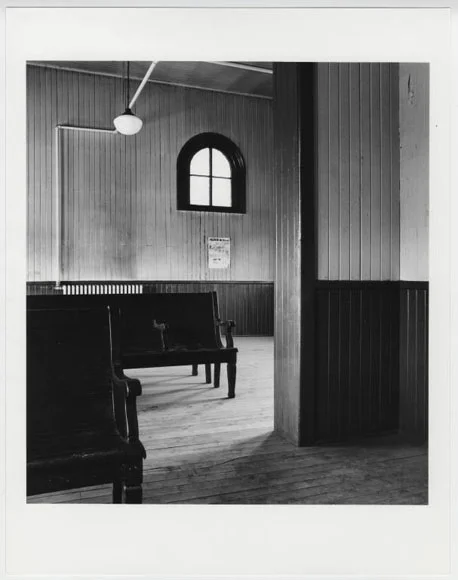
Waiting Room, former Chicago & Eastern Illinois Railroad, 1966. David Plowden.
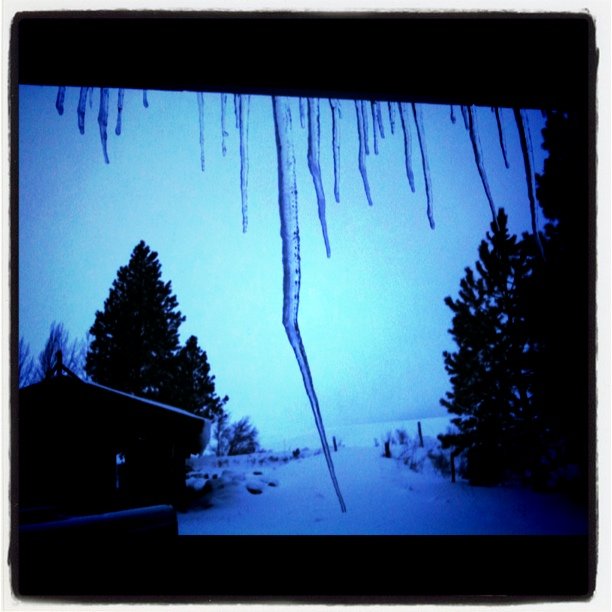
Wind-bent icicles.

Tomer Butte, lenticular cloud, fireball sun.
“When my family and I raised chickens on our farm in Henry County we realized a net profit of $6,000 on the sale of 2,000 chickens processed over the course of five months. A factory farm realizes a profit of $20,000 to $30,000 on the sale of 1,200,000 chickens.
…
The grain farm and the hog and chicken farm are the result of a modern industrial mind, a mind that refuses to accept any context.”
From “Agriculture vs. Agribusiness”, by Wendell’s daughter Mary Berry Smith, on Front Porch Republic.
The Berry family made a profit of $3 per chicken. The factory farm made a profit of—assuming the $30,000 number—two and a half cents per chicken.
Last summer, I went in halfsies on an 800-bird chicken business. After all the capital outlays (chicken housing, feed, a plucker, other assorted items), a loss of over 100 chickens to some hard Spring weather, the diversion of another 120-150 chickens to our own freezers, we still made a wildly better per-bird profit (spread out over the 800 birds, not the 550+ that we sold) than the industrial chicken operation.
This song singlehandedly talked me into buying all of her records. John and Joey from Calexico were the nucleus of the backing band, giving the familiar folk-rock elements startling and surprising turns. Every phrase in this song sets a scene and tells a story, and no one but her could sing them. Pitchfork interviewed her in 2006 and she had a thing or two to say about the lyrics.
“Words are polluted. Plots are polluted. In the best movie of last year, a disturbed young man played by Timothy Hutton consults a psychiatrist a couple of times, breaks down, hugs the psychiatrist, says “I love you,” and is cured. He also has a communication problem with his father. They both break down, hug, cry, say “I love you.” All is well. Lines of communication are opened. Love is the answer. Who is going to protect words like “love,” guard against their devaluation?…There may be times when the greatest service a novelist can do his fellow man is to follow General Patton’s injunction: Attack, attack, attack. Attack the fake in the name of the real.”