
The old Palouse & Lewiston in the canary grass by the E. Whittier Road crossing, Spokane County, Washington.
“While I was still in the hospital, I thought a lot about the fact that our life is a gift. My life was a gift before this all happened, but my sense of the dramatic wonder of that fact has deepened considerably. The Creed that we regularly recite refers to the Holy Spirit as the Lord and Giver of life. It’s all too easy to recite that phrase as a matter of cold theological description. We can affirm such things with a kind of clinical detachment, rather like the medical report of my condition read by the doctors and nurses caring for me last month. But theology should always issue in doxology, and since my experience of the near loss of life, the vocabulary of “gift” and “gratitude” has been enriched.
So has my appreciation for the way our loving prayers are a participation in God’s own life. For some time I have been intrigued by the ancient idea of “perichoresis,” the term first used by Gregory of Nazianzus to describe the mutual indwelling of the members of the Trinity. In John 17, Jesus prays that just as he is in the Father and the Father is in him, so believers will be in the Triune God and one with one another: “I in them and you in me.” The Trinity is a dynamic dance of the giving and receiving of love, and by grace we enter into that dynamism through the work of Christ.
Having been given back my life—as the prayers of hundreds of believers engaged in the life of the Triune God—I think that I have a better apprehension of what this means, which is not to say that I can describe it any better. It is finally a mystery, providentially underscored in my life in the season in which mysteries (and gifts and gratitude) abound.
”

William Eggleston, Untitled (Police Car, California).
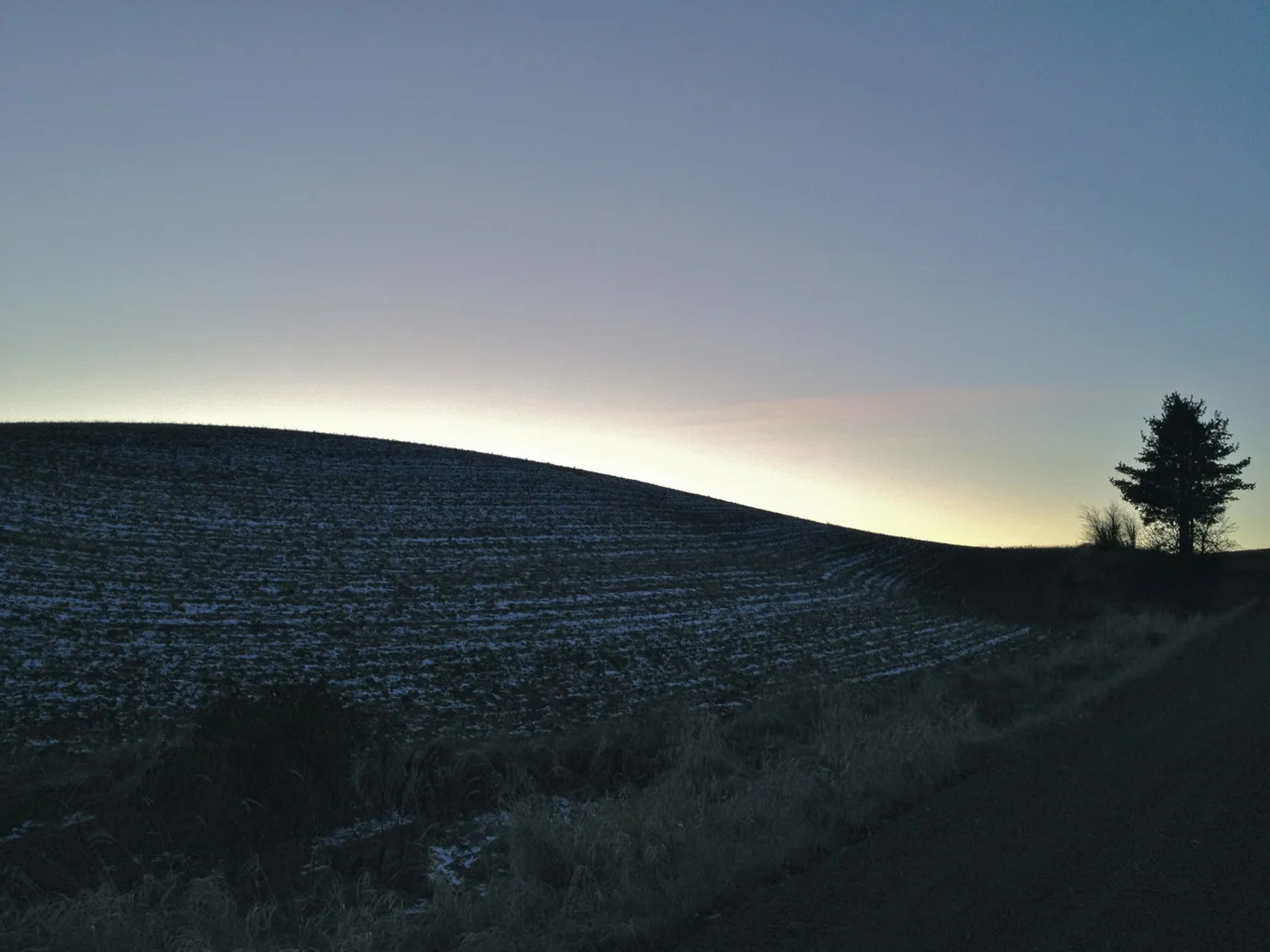


Blair Kooistra’s picture of a westbound Milwaukee Road freight rumbling over the concrete arch viaduct in Rosalia, Washington. Here’s a view of the viaduct as it exists now.
The Geography of Stuck →
In which someone named Richard Florida opines that, “America can be divided into two distinct classes, the stuck and the mobile. The mobile possess the resources and the inclination to seek out and move to locations where they pursue economic opportunity. Too many Americans are stuck in places with limited resources and opportunities. This geography of the stuck and mobile is a key axis of cleavage in the United States.”
What about people who like where they live and are committed to those places? Are they “stuck”?
“ALMIGHTY God, give us grace that we may cast away the works of darkness, and put upon us the armor of light, now in the time of this mortal life, in which your Son Jesus Christ came to visit us in great humility; that in the last day, when he shall come again in his glorious majesty to judge both the quick and the dead, we may rise to the life immortal, through him who lives and reigns with you and the Holy Ghost, now and unto ages of ages. Amen.”
“Advent seems to be about the shame of God, but this is nothing new. Long before the incarnation, God risked shame. He chose elderly Abraham and his barren wife—strangers and aliens, without country, without city, without seed—as the unlikely parents of His people. Yahweh became their God. Long before Jesus, God began to enter into flesh.
Whenever we commit to people and causes and projects, we place ourselves at the mercy of others. We put our reputations and names on the line. Will our chosen spouse be faithful? Will our children embarrass us? Will the others working on this project pull their weight? Will we risk everything, and lose? Will we be ashamed?
In His eternal humility, God puts His reputation on the line by allying with strangers, and Hebrews says “God is not ashamed to be called their God.” Abraham and Sarah trusted and died in faith, though they greeted the promise only from a great distance. They sought a heavenly city prepared by God, and God was vindicated in their trust.
And God is not ashamed to take flesh because in the flesh Jesus proves Himself a true Son of Abraham. Even when He faces the cross and grave, Jesus trusts His Father, and God is not ashamed to call Him Son.
We bear the name of the Triune God. The Spirit dwells in our flesh. God entrusts His Name and future to us, and calls us to be His covenant partners. Will we vindicate Him by the faith that overcomes the world? Or will He be ashamed to call us His people?
”

Brandon Sheard quarters a side of pork. This is via The Anatomy of Thrift.
“Father George Zabelka was chaplain to the Hiroshima and Nagasaki squadrons that dropped the bomb, and administered the Eucharist to the Catholic pilot [who] dropped it. He later renounced his actions: “To fail to speak to the utter moral corruption of the mass destruction of civilians was to fail as a Christian and as a priest as I see it… . I was there, and I’ll tell you that the operational moral atmosphere in the church in relation to mass bombing of enemy civilians was totally indifferent, silent, and corrupt at best – at worst it was religiously supportive of these activities by blessing those who did them.”
The most tragic statement: “Catholics dropped the A-bomb on top of the largest and first Catholic city in Japan… . One would have thought that I would have suggested that as a minimal standard of Catholic morality, Catholics shouldn’t bomb Catholic children… . I walked through the ruins of Nagasaki right after the war and visited the place where once stood the Urakami Cathedral. I picked up a piece of the censer from the rubble. When I look at it today I pray God forgives us for how we have distorted Christ’s teaching.”
”
Peter Leithart, “Priests Dropping Bombs”.
In light of this and this, the modern American church is, when considered in relation to its support of our current batch of illegal foreign wars, identical to Father Zabelka.
November 20th. I can’t wait.
The man asked could God make a taco so terrible even He could not eat it. →
Cormac McCarthy, were he to review a Taco Bell on Yelp.
Plenty of you already know the ins and outs of making an Old Fashioned, but let’s start the week out with a baseline.
Who better to set this standard than Chris McMillian. McMillian is something of a legend. He’s a fourth-generation bartender who’s been making classic cocktails long before they were popular (again.) This video was shot at the Library Lounge in New Orleans but you’ll find him at at Bar Uncommon these days.
New Olreans Best Cocktails: The Old Fashioned (by keithmarszalek)
You might want to click through to see the rest of his videos.
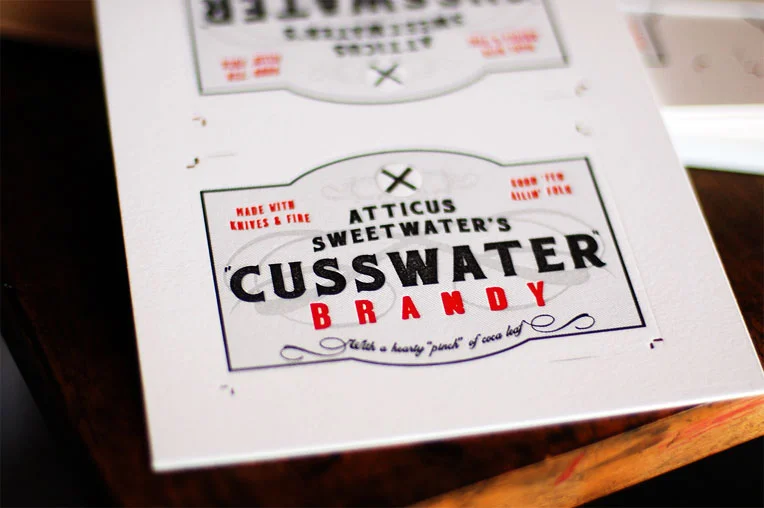
“Beauty is cosmic order understood as gift.”
“And he’s the Person who came up with the platypus… and the emerald. And Hieronymus Bosch’s brain. He’s the thing behind the thing, and so don’t fear. You can love bizarre stuff and still be in his eye.”
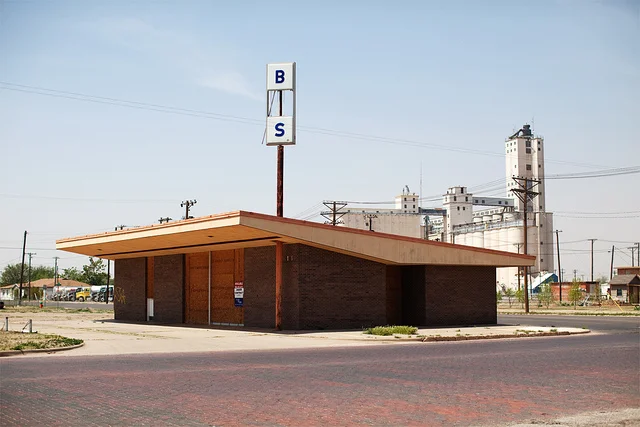
Bus Stop, Plainview, Texas, by Charles Henry. Discovered at American Elegy.
There’s nothing more beautiful than a shovel. →
Randy Fox interviews David Plowden at his American Elegy site.
Alan Jacobs on Steve Jobs' oft-quoted Stanford commencement address →
Alan Jacobs’ comments are good. I would add this: for all the talk of the world-changing (or, even, universe-denting) stuff Jobs did with Apple, what fundamentally matters is how the man was to the people closest to him. Was he available to his children? Did he pour himself out for his wife as he did for his company? Did he have love? Or was he sounding brass and clanging cymbal? Of course, being apart from the Son of the God who is love—as Jobs was—no one can have love. And by all accounts, he was hard to be around. Many stories about Jobs indicate that he was personally irascible, hot-tempered, and an awful person to be around—but that’s all okay, they hasten to add, because he was an inspiring visionary.
From all accounts, he was sounding brass and clanging cymbal, a man in tune with the future (whatever that means), but out-of-tune with the people who had to live with him.