Levon Helm died today. Here’s the Drive-By Truckers with a song about the deaths of two other members of The Band.
“Christians can embrace all the relativities and penultimacies of history without becoming relativists or skeptics—not because we have a certitude behind us but because we are confident that we have certitude ahead of us.”
Peter Leithart, Foundations.
Peter routinely writes things like this that become fixed points in how I look at life (here’s another).
“Unless the novelist has gone utterly out of his mind, his aim is still communication and communication suggests talking inside a community.”
The Trinity and human relationships
Some thoughts developed with a little help from Peter Leithart. By “a little help” I mean things like “forming my understanding and belief in the possibility of everything mentioned here”…
The Father gives the Spirit to the Son; the Son receives the Spirit and then gives the Spirit back to the Father, who receives the Spirit and then gives, etc… this inter-trinitarian giving is the basis of human relationships, and the relationship between God and man.
God gives (he initiates), and we receive. When we receive, then we may give. When we give, we give expecting to receive back something glorified.
God’s initial gift to us enables us to enter into this Trinitarian dance of gift. That initial gift is the Spirit. When He gives His Spirit to us, we produce the fruit of the Spirit and thus we offer the Spirit back to God. Giving the Spirit back to God, we expect him to return to us glorified, a fresh outpouring of the Spirit that proves even more fruitful than before.
Likewise, God gives people to us (wife, children, friends, even enemies); we receive them and we then give those people back to God. When a husband gives his wife, he expects her to return to him more lovely, for instance. When parents give their children, they receive them back. This is most dramatically illustrated in baptism: the parents hand the child to the minister. The minister baptizes the little one. Then the parents receive their child back, a new creation over which the Spirit now hovers.
More intriguing, when one gives his enemy, he may receive that enemy back as a defeated enemy—or even as a friend. “Vengeance is mine…” and so forth. We give up enemies by forswearing vengeance, bitterness, wrath, and so on, and commit them to God by praying the words of the psalms of complaint.
This shall be sung at Easter by the Trinity Reformed Church choir. Until that time, when the voices of my brothers and sisters are singing it, this recording shall have to do. If you listen to this, stop whatever else you’re doing to take it in.


Lalibela Church, Ethiopia
The town of Lalibela in northern Ethiopia is renowned for 12 Christian churches that were hewed out of solid stone some 800 years ago. The most stunning is Bieta Giyorgis, shown here, a massive monolith 40 feet (12 meters) tall, intricately carved and shaped like a cross.
Via: NPR
“O thou who art the sparrow’s friend,” he said, “ have mercy on this world that knows not even when it sins. O holy dove, descend and roost on Godric here so that a heart may hatch in him at last. Amen.”
“Erc was a great cairn of a man. His belly was where the stones buckled out under their own weight. His feet was where a pair of them had tumbled to the ground. His head was a boulder on top that was cracked straight across. He could open this jagged crack of a mouth wide as a stone cave and bellow out of it all manner of wild flummeries he’d learned from the days when he was a druid.
“Ah-h-h-h! Yah-h-h-h! God is the wind that blows over the sea… the wave of the deep… the bull of the seven battles… the tear in the eye of the sun.”
His breath had the musty moulder and damp of caves to it. The words rushed forth thick as bats but more of them got left within that ever come out because there’s never been the likes of druids for secrets.”
“Ailred was fourth. They say as a babe he reared up like a lily in his tub and spoke the Pater Noster through nor would take of his mother’s teat for the forty days and night of Lent save Sabbaths. He grew to a sheaf of bones made fast round the middle with a monk’s rope.
The pictish king of Galloway was the devil fleshed. He had the gold eyes of a toad and a forked beard. On cold nights he’d slit a slave’s belly open like a sack so he could dabble his feet in the warm bowels. He tied together the limbs of women in labor for sport and drank blood. Ailred went to him. Throned on a rock, the king was picking his teeth with the bone of a weasel when Ailred knelt and watered his shins with tears. They say a light went forth from Ailred then that blinded the king’s gold eyes, and a creature was seen passing forth out of the king hung all over with bottles of the blood he’d drunk, and the king swore holy faith from that day on and took him the name of Ailred for his own. Thus with no loss of seed or purity, my friend got him a son that day upon the rock, and Jesu a forkbeard, pictish knight though blind as a bat from that day on.”
“In his 1939 lecture on Sacred and Secular in Art and Industry, Eric Gill compared the artist and the modern industrial laborer. They have much in common: “Both are normally engaged in making things. Both are normally workers with their hands. Both are normally paid for what they do and not paid if they don’t do it. (In this respect unlike either the man of business or the politician.) Both are commonly instructed as to what is required of them before they begin working.” Gill argued that the key difference is one of responsibility: “The artist is responsible for the form and quality of what his deeds effect; he is the responsible workman; he has responsibility and would be insulted if he were denied it; but the workman, the labourer, the hireling, the factory hand has been, as the theologian puts it, reduced to a sub-human condition of intellectual irresponsibility; he neither has responsibility nor does he now desire it. He is too deeply corrupted by his serfdom. The hireling flieth, because he is a hireling.”
Gill argues further that the detachment of labor from artistic responsibility for the products of labor distorts modern understanding of the “fine arts.” Fine arts are “very important and even enthralling,” he says, but “only as important and enthralling as they now are by reason of the fact that the common arts in our sort of mechanized society do not give any scope for the satisfaction of those specially fine feelings which our fine artists are now the special purveyors of.””
Flannery O'Connor reads A Good Man is Hard to Find at Notre Dame in 1959, I believe. Good Man is the first Flannery story I read, and it was probably the first story that ever shocked me—my jaw actually dropped. I remained completely startled and unsettled by it in my subsequent readings of it until I heard this recording, when for the first time I could hear how funny it is, too (“his head was as smooth and round as a cabbage…”).

Western Steam no. 17: Union Pacific passenger special, Medicine Bow, Wyoming by Joel Jensen (first discovered in his book Steam: An Enduring Legacy).

Great Plains no. 15: Last light by Joel Jensen.
Birmingham Is Not New York: 5 Cautions for Arts Ministry →
Via commentmagazine:
Start with where you are. If your church is in a region with a strong history of quilt making, that should be the starting point for your arts ministry. Don’t open with a white cube gallery space. Take a lot of time to listen to the artists and designers in your church to understand the history and legacy of the creative process in your region. Think outside just painting and architecture. Contra dancing, shape-note singing, and street art murals are a few of the examples of regional art that you ought to spend time thinking about and participating in. Before turning your narthex into a gallery, why not ask experienced woodworkers in your congregation to make a table for communion? Before trying to create a concert space where touring bands can play, support already existing local efforts to promote music.
What if your church is in a region that doesn’t have a strong tradition of anything?




A short Washington & Idaho Railway freight trundles over two of the few remaining rails left on the Palouse. Near Belmont, Washington, mid-December, 2011.
As it happens, my buddy Joel P. King was at the throttle on this one.

Shuttered, The Dalles, Oregon.
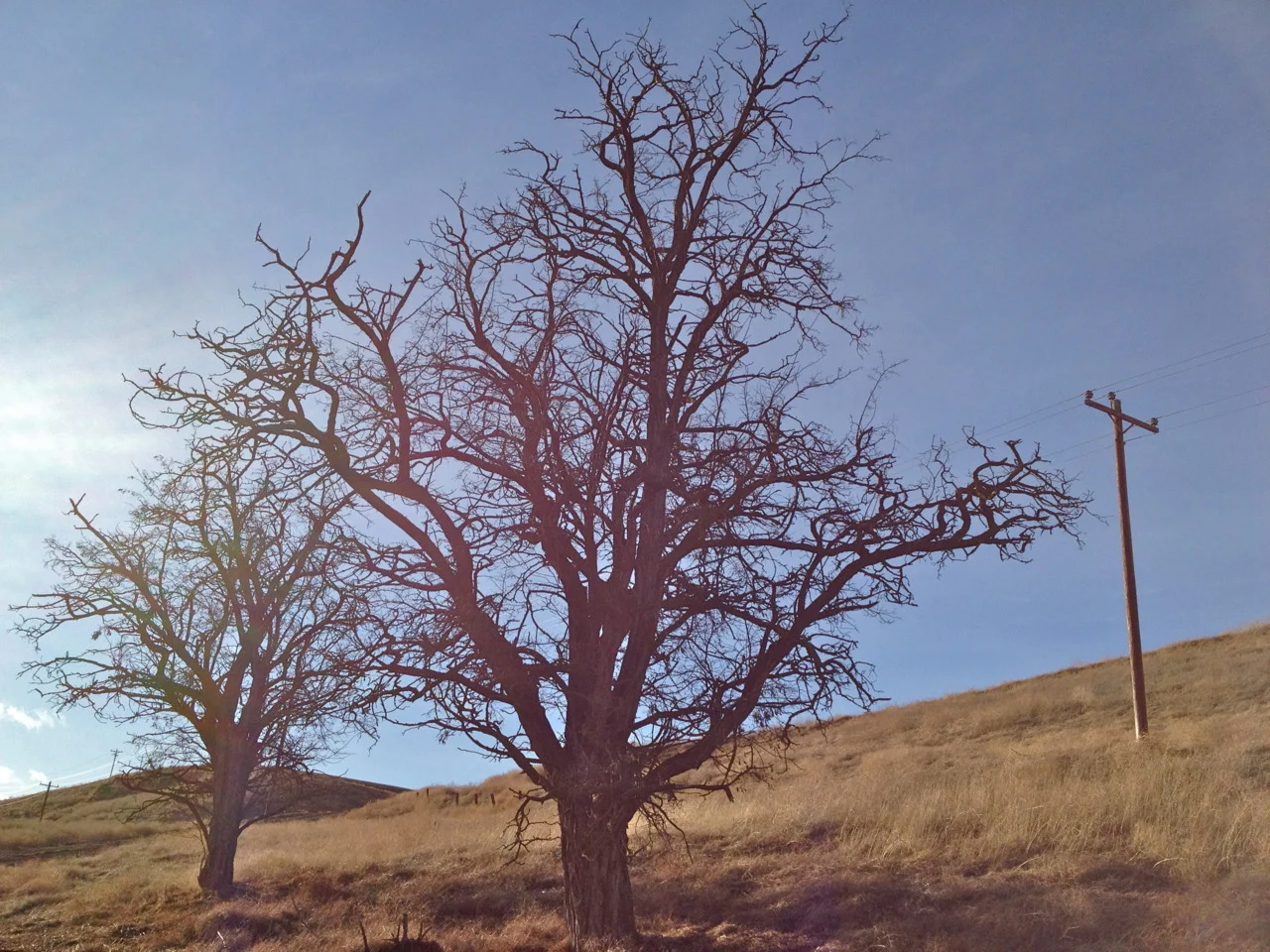

Trees in the low winter sun, Columbia County, Washington.

J.C. Penney Co., The Dalles, Oregon. William Eggleston I ain’t, but I’m trying.
“If you understand your own place and its intricacy and the possibility of affection and good care of it, then imaginatively you recognize that possibility for other places and other people, so that if you wish well to your own place, and you recognize that your own place is a part of the world, then this requires a well-wishing toward the whole world.
In return you hope for the world’s well-wishing toward your place.
And this is a different impulse from the impulse of nationalism. This is what I would call patriotism: the love of a home country that’s usually much smaller than a nation.
”