Curing without nitrites. From the folks behind Farmstead Meatsmith via Anatomy of Thrift.
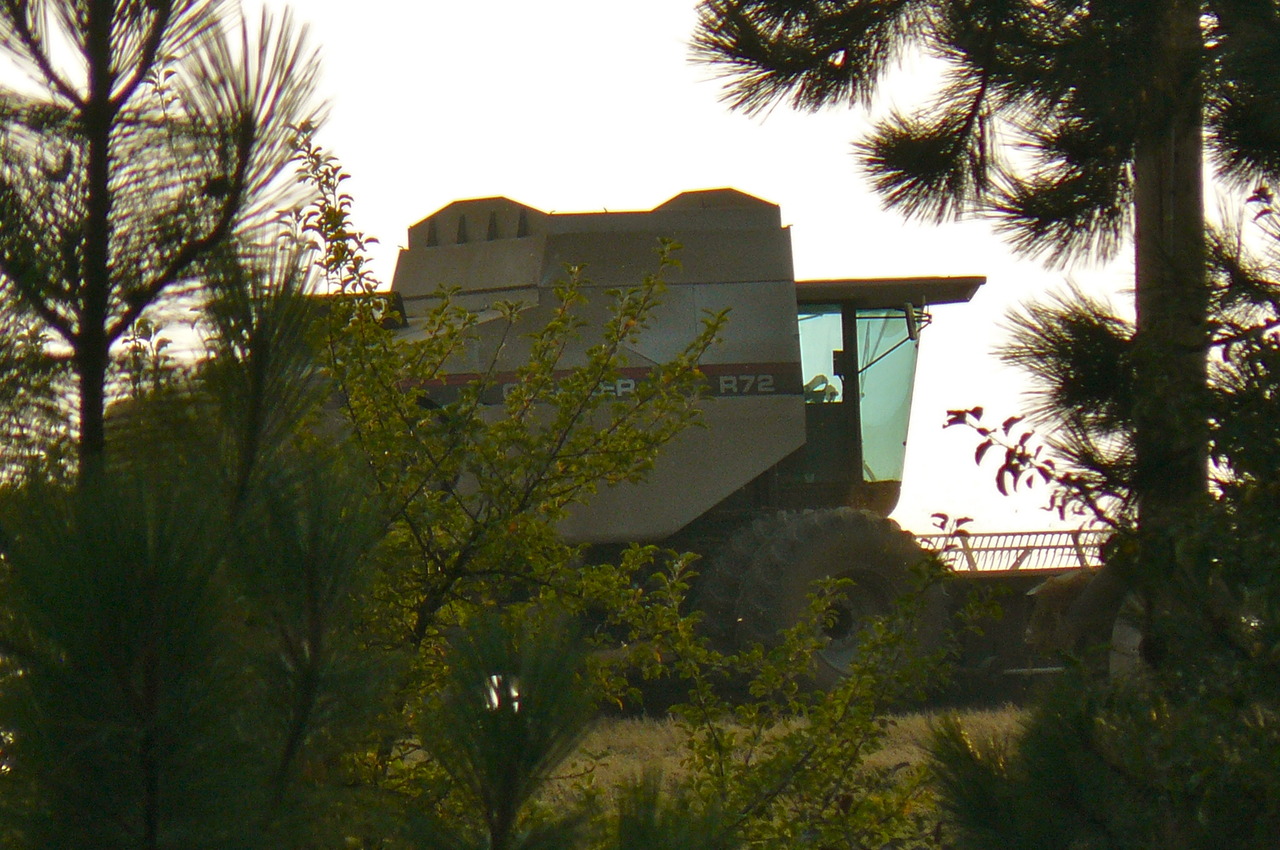

“Let them stand still for the bullet,
and stare the shooter in the eye,
let them die while the sound of the shot is in the air,
let them die as they fall,
let the jugular blood spring hot to the knife,
let its freshet be full,
let this day begin again the change of hogs into people,
not the other way around,
for today we celebrate again our lives’ wedding with the world,
for by our hunger, by this provisioning, we renew the bond.”
“For the Hog Killing”, by Wendell Berry. Not wild about the poetry itself, but the sentiments behind it hit home for me; I’m keeping six hogs that I shall start slaughtering about seven weeks from now. From the just-posted interview, some of Berry’s commentary:
You see there was a whole system of practical acts that gathered in respect for the hog. In the culture that I grew up in, one of the firm laws of hog killing was never to make them squeal. If they squealed after you shot them, you had done a bad job. You had hurt them. Doing it well was an act of reverence—a practical, economic act—but at the same time, it was an act of reverence for the creation and for living things. You’re not going to find a big slaughterhouse with the ethical imperative, “don’t let them feel it.”
…
Bad emergent properties, bad surprises, on that scale are the result of cultural failure—the unwillingness, even the inability, to be a good neighbor to one’s neighbors. As I knew them, hog killings were accomplished by neighbors working together. And what those people understood perfectly—and I don’t think the religious connection was ever brought out in church—was that you knew if you loved your neighbor, you had to get out of your chair. If I sit here in my chair and I say, “neighbor, I love you,” what the hell difference does it make? You have to be able to help. And when you’re needed, you have to go.
The old ethic—our rule in work at home—was, “nobody is done till everybody is done.” And when it was tobacco harvest, you knew you were going to be there till you and all your neighbors were done. You were going to be working together; you were going to be sweating together. We didn’t go around talking piously about loving each other, but we did love each other. It’s like a football team: you’ve been through a lot together; you know each other’s motions. You look at the figure of your neighbor on the horizon at his work, and you recognize every gesture with this profound sympathy that you feel in your own flesh. You know what he’s going to do. This is as intimate as knowing how to dance together.
Interview with Wes Jackson and Wendell Berry in The Hedgehog Review →
I’ll get this out of the way: lots to quibble with in this interview. Nonetheless, Wendell Berry makes me re-think what the church should be doing like few others can. Some quotes to whet your appetites:
…and meanwhile, we’ll let the churches be in charge of getting people to heaven, and they won’t have to worry about our economic life at all. And the arts will concern themselves with nature but only as subject matter, only as a source of metaphors. That’s wrong, in my opinion. I think all the disciplines gather under the meaning of economy, the making of the household, the making and maintenance of the human household, and that involves everything.
When you’re talking about the land use economies, you’re talking about the fundamental economies. What we are talking about are the arts of life, and the fundamental arts of life are the arts of land use. We have preferred to think of the arts of life as the arts of living, the code of hospitality to guests, good table manners, and so on. But the issue is more economic and more serious than that. So if we began to think about all the arts of life, then we would maybe have the beginning of a real criticism. Are these good arts or bad arts?
And the engineering arts also are economic arts. They are the way that we construct, so to speak, the household of the human economy. And to turn the construction of that household over to a bunch of materialist specialists is a serious mistake.
From Ghosts of the Great Highway, a record that is still improving on each listen for me… like Richard Buckner's Meadow, a record that has quietly become one of my all-time favorites without my having really noticed.

Wind project under construction, Naff Ridge, Whitman County, WA.

Parts, S. Cedar Street, Spokane, Washington.

Collapsing wall on abandoned grain elevator, Dry Creek Road, Whitman County, WA.
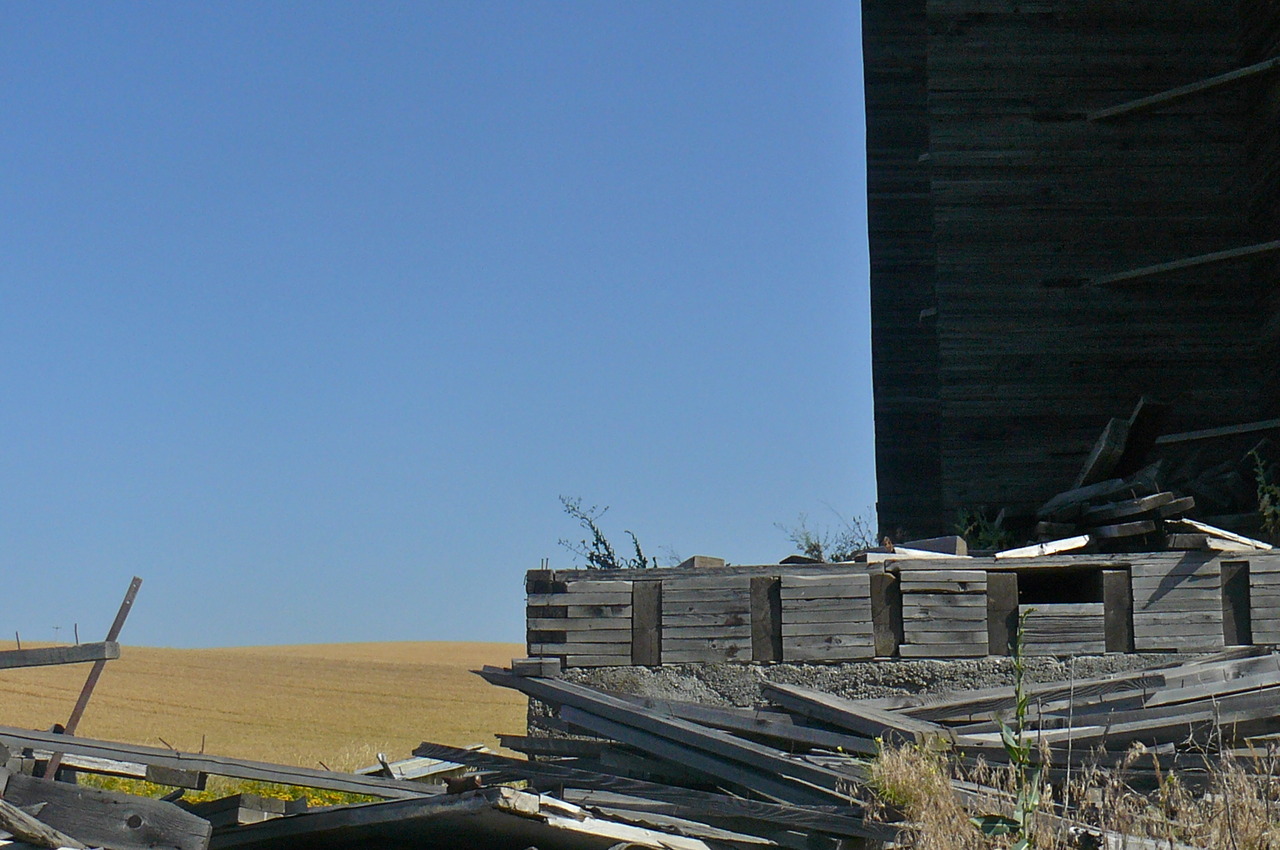
Remains of grain elevator, Dry Creek Road, Whitman County, WA.

Marshall, Washington.
Watch the transition from the first shot to the second.

Stateline Road, Walla Walla Valley.

Tattered flag, approaching storm, Walla Walla County, WA.
Theotokos →
I don’t do internet fights, especially over theological matters, and this post is in no way meant to start some protracted battle over the veneration of Mary—which practice I oppose. I’m simply writing this out because On That Hill is a better forum for my thoughts than Twitter, and I wanted to give Señor Jamey Bennett, taco-lover and Orthodox food dude, something better than inarticulate 140-character missives.
Mrs. Boychuk’s article, linked above, seems to summarize the Orthodox, and for that matter, the Roman Catholic position in favor of the veneration of Mary… as well as the practice of praying to her, seeking her intercession, etc. At least, it doesn’t introduce anything I haven’t heard before (in various contexts): Mary as the new Eve, Mary as a kind of prophet, as a kind of ark, etc. I’ve heard this from the veneration-of-Mary arguments, but I’ve heard far more of it in my own circles. I sit under Peter Leithart, a man whose exegesis wrings countless riches from any given text—I hear all of this and more every year during Advent and Christmas. Yes, Mary is all these things; she’s also a new Sarah bearing a new Child of promise, a new Deborah singing a new song of deliverance, a new Ruth being lifted from the dust heap, and so on. She is all these things, and more, and together with these other women (and the other women mentioned in the gospels), she looks forward to the ultimate Woman: the church, the Bride of Christ. I’m all for typological readings of Scripture; the Irenaeus quote is a leading candidate for the back tattoo I hope my wife will someday let me get. But this reading of Mary from the above-linked article, you could say, doesn’t go far enough for me.
Then there’s this:
…Orthodox Christians argue that no ordinary woman could give birth to God’s Son and that she was chosen by God because she was a holy young girl whose will was aligned with His Will. Certainly, she was ordinary in that she was a human being like the rest of us, but her submission to God set her apart for the most important job a human could ever fulfill.
“…because she was a holy young girl…”? But the angel said:
“Rejoice, so highly favored! The Lord is with you!… Mary, do not be afraid; you have won God’s favor…"That’s from The Jerusalem Bible.
Not, "Hey, rejoice, holy one! You’re the only one up for this job Yahweh has for you…” It’s, “Rejoice, favored one!” Rejoice, you who the scribes and priests couldn’t give a crap about, you who the Romans would kill and rape if they got ornery enough, you poor and meek woman of the earth: God is going to up-end the world the way he always does—through a woman of no reputation.
The New Testament is studded with characters like this—a poor girl who appears to be knocked-up who bears the Christ, a gaggle of illiterate fishermen who preach the gospel before kings, a tax collector who records the Sermon on the Mount, a sonofabitch murderer who becomes the Prince of the Apostles. God doesn’t choose people to do great things because of their merit. He takes strength and makes it weak, and then turns weakness into strength. I can’t think of anywhere where God chooses the person whose “submission to God set her apart for the most important job a human could ever fulfill.” But we could multiply examples of the opposite…
Concerning Mary’s perpetual virginity, even granting all of Mrs. Boychuk’s points, I still don’t see how it’s Biblically necessary for Mary to have remained a virgin. The story of redemption leads to consummation, a wedding scene, a Bride adorned for her husband. As for Joseph thinking of Uzzah touching the ark, he probably would have remembered that Uzzah touched the ark while God was still inside it, as it were. And from Matthew’s account, it’s entirely reasonable to assume that he kept his hands off during her pregnancy, for a number of reasons that may have included grim memories of Uzzah. But afterwards, being a just and righteous and devout Jew who knew the law, he probably would’ve hastened to Exodus 21:10 and her conjugal rights, God having left the ark, as it were.
I know I haven’t answered every part of the article; this is already a hundred times longer than I wanted it to be. Before I conclude, let me hasten to mention that I in no way wish to disparage Mrs. Boychuk or Mr. Bennett. I am also sure I have said nothing that they haven’t heard before, having their Christian origins in Protestant circles (and Mr. Bennett being well acquainted with many of my teachers and sources). Though they’d refuse the bread and wine I as a deacon would serve them (were they to visit Trinity Reformed Church) and I’d be left outside with the Philadelphia hungry at Mr. Bennett’s church, they are not enemies of the cross of Christ, and so I consider them my siblings.
With that out of the way, I can’t really say it any better than the angel who spoke with John near the end of Revelation, when John knelt at his feet to worship him: “Don’t do that! I am a servant just like you and like your brothers the prophets and like those who treasure what you have written in this book. It is God that you must worship.”
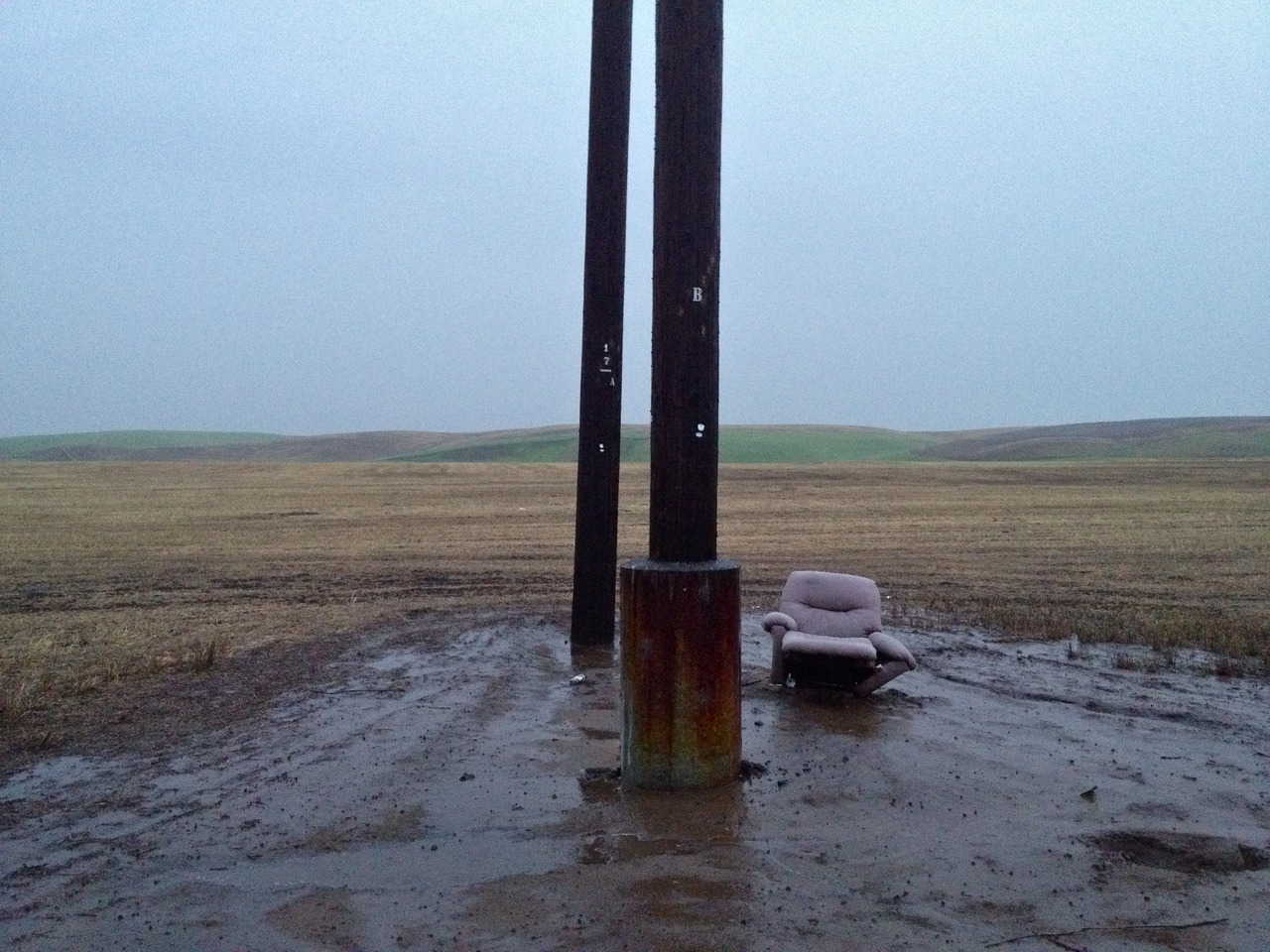
Old easychair in the rain, Walla Walla County, Washington.

Sapolil Road, Walla Walla County, Washington.
Rules of storytelling
Via Emma Coats’ blog, Story Shots, and the Pixar blog… reproduced here only because I want to make sure I can quickly find these for my own future reference.
#1: You admire a character for trying more than for their successes.
#2: You gotta keep in mind what’s interesting to you as an audience, not what’s fun to do as a writer. They can be v. different.
#3: Trying for theme is important, but you won’t see what the story is actually about til you’re at the end of it. Now rewrite.
#4: Once upon a time there was ___. Every day, ___. One day ___. Because of that, ___. Because of that, ___. Until finally ___.
#5: Simplify. Focus. Combine characters. Hop over detours. You’ll feel like you’re losing valuable stuff but it sets you free.
#6: What is your character good at, comfortable with? Throw the polar opposite at them. Challenge them. How do they deal?
#7: Come up with your ending before you figure out your middle. Seriously. Endings are hard, get yours working up front.
#8: Finish your story, let go even if it’s not perfect. In an ideal world you have both, but move on. Do better next time.
#9: When you’re stuck, make a list of what WOULDN’T happen next. Lots of times the material to get you unstuck will show up.
#10: Pull apart the stories you like. What you like in them is a part of you; you’ve got to recognize it before you can use it.
#11: Putting it on paper lets you start fixing it. If it stays in your head, a perfect idea, you’ll never share it with anyone.
#12: Discount the 1st thing that comes to mind. And the 2nd, 3rd, 4th, 5th – get the obvious out of the way. Surprise yourself.
#13: Give your characters opinions. Passive/malleable might seem likable to you as you write, but it’s poison to the audience.
#14: Why must you tell THIS story? What’s the belief burning within you that your story feeds off of? That’s the heart of it.
#15: If you were your character, in this situation, how would you feel? Honesty lends credibility to unbelievable situations.
#16: What are the stakes? Give us reason to root for the character. What happens if they don’t succeed? Stack the odds against.
#17: No work is ever wasted. If it’s not working, let go and move on - it’ll come back around to be useful later.
#18: You have to know yourself: the difference between doing your best & fussing. Story is testing, not refining.
#19: Coincidences to get characters into trouble are great; coincidences to get them out of it are cheating.
#20: Exercise: take the building blocks of a movie you dislike. How d’you rearrange them into what you DO like?
#21: You gotta identify with your situation/characters, can’t just write ‘cool’. What would make YOU act that way?
#22: What’s the essence of your story? Most economical telling of it? If you know that, you can build out from there.
Levon Helm died today. Here’s the Drive-By Truckers with a song about the deaths of two other members of The Band.
“Christians can embrace all the relativities and penultimacies of history without becoming relativists or skeptics—not because we have a certitude behind us but because we are confident that we have certitude ahead of us.”
Peter Leithart, Foundations.
Peter routinely writes things like this that become fixed points in how I look at life (here’s another).
“Unless the novelist has gone utterly out of his mind, his aim is still communication and communication suggests talking inside a community.”