The Lord’s Prayer from Rachmaninov’s world-stopping Liturgy of St. John Chrysostom, performed by the Cambridge King’s College Choir.
Mullein on a clear Winter day.

Mullein on a clear Winter day.

“Parking garage, Adolphus Theater” by William Reagh, a photographer who lensed Los Angeles and its surroundings from the late 30’s until about 1991. I don’t know L.A. very well, but stuff like this is nevertheless just fascinating. The Los Angeles Public Library has a collection of his images that you should go get sucked into now. It’s good, solid, documentary stuff, with a fine sense of composition and light.
The Lord’s Prayer from Rachmaninov’s world-stopping Liturgy of St. John Chrysostom, performed by the Cambridge King’s College Choir.
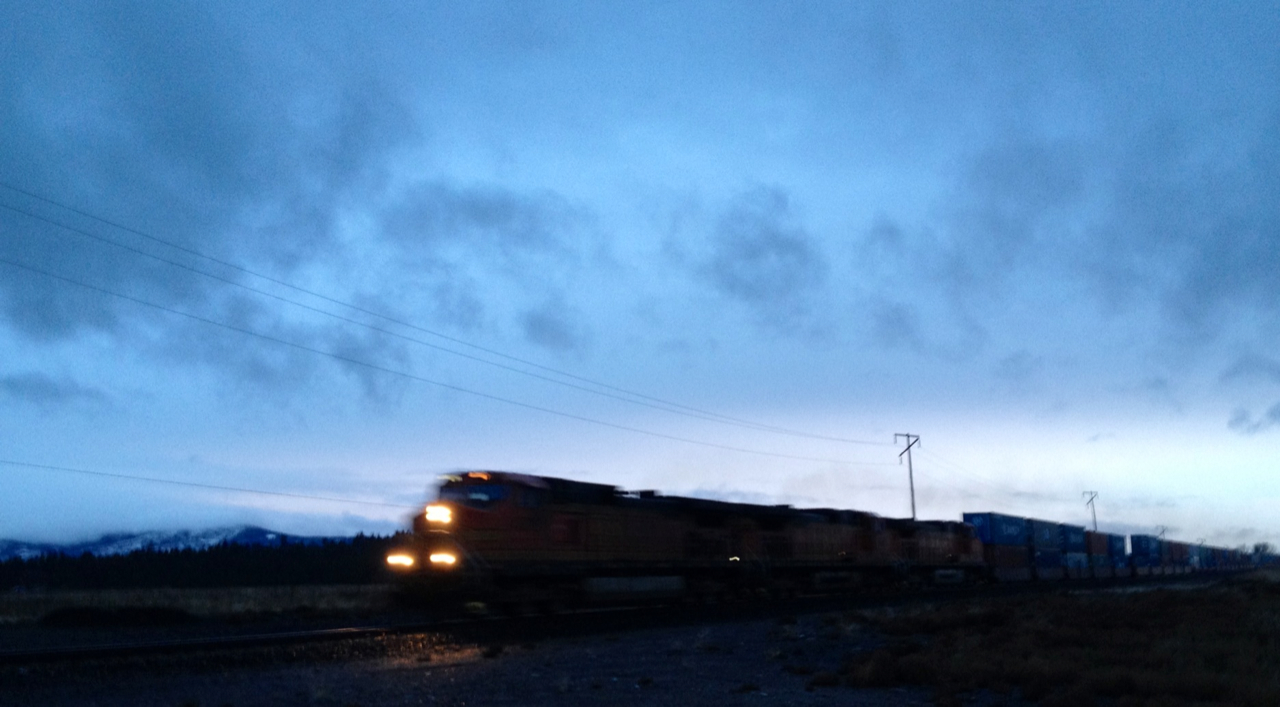
Eastbound BNSF stack train races out of Spokane in the failing late December light.
“There are meals that come in courses. Meals that use broths boiled for 24 hours, cuts of pork kneaded daily for a week. Meals in which humans share their humanness and become open and vulnerable with one another. You could call my hamburger a meal, but then you’d have to call piss marks in the sand a work of art.”

Blair Kooistra, photographer: Old forty-foot Northern Pacific boxcars loaded to their 50 ton capacity with wheat clomp across a rural grade crossing near Creston, Washington, bound east on the CW local returning to the mainline at Cheney. High-capacity hopper cars have just about done in the movement of wheat in boxcars in the west; in a few years, such scenes will cease to exist.
The Dying of thirst passage of this song is astonishing. Even more astounding is how important the skit at the end is to the song—and to the entire record. How is it that a blockbuster rap record climaxes with a baptism scene and the words, “Remember this day, the start of your new life, your real life…”?
good kid, m.A.A.d city might be my favorite record of the year.
Paul Hillier directs what I think is the definitive recorded performance of Arvo Pärt’s time-stopping Magnificat. The rich are sent empty away.


The Inland Northwest, as seen by satellites at night. In the northeast of the image, Spokane and Coeur d'Alene. Move south from there through the scattered pinprick towns of the Palouse through the twin lights of Pullman and Moscow down to Lewiston-Clarkston. Go west from L-C through Pomeroy, Dayton, and Waitsburg to Walla Walla (the city shaped like a hatchet). Then west again to the crab-shaped Tri-Cities and curving along the crescent of light in the Yakima Valley. North, then, from Yakima, through Ellensburg and to the Wenatchee Valley. Then back east, skirting Moses Lake and across the dark distances to Spokane.
My main thought looking at this dark and abstracted map is that I love where I live.
I loved Freaks and Geeks when it first aired. This pitch-perfect scene makes me want to revisit it. Bill alone making himself a grilled cheese. The mirroring shots between him and Garry Shandling (drinking, teeth, Bill pointing at himself). The laughing with food in his mouth. Comedy with this kind of pathos is, I think, one of the highest art forms.
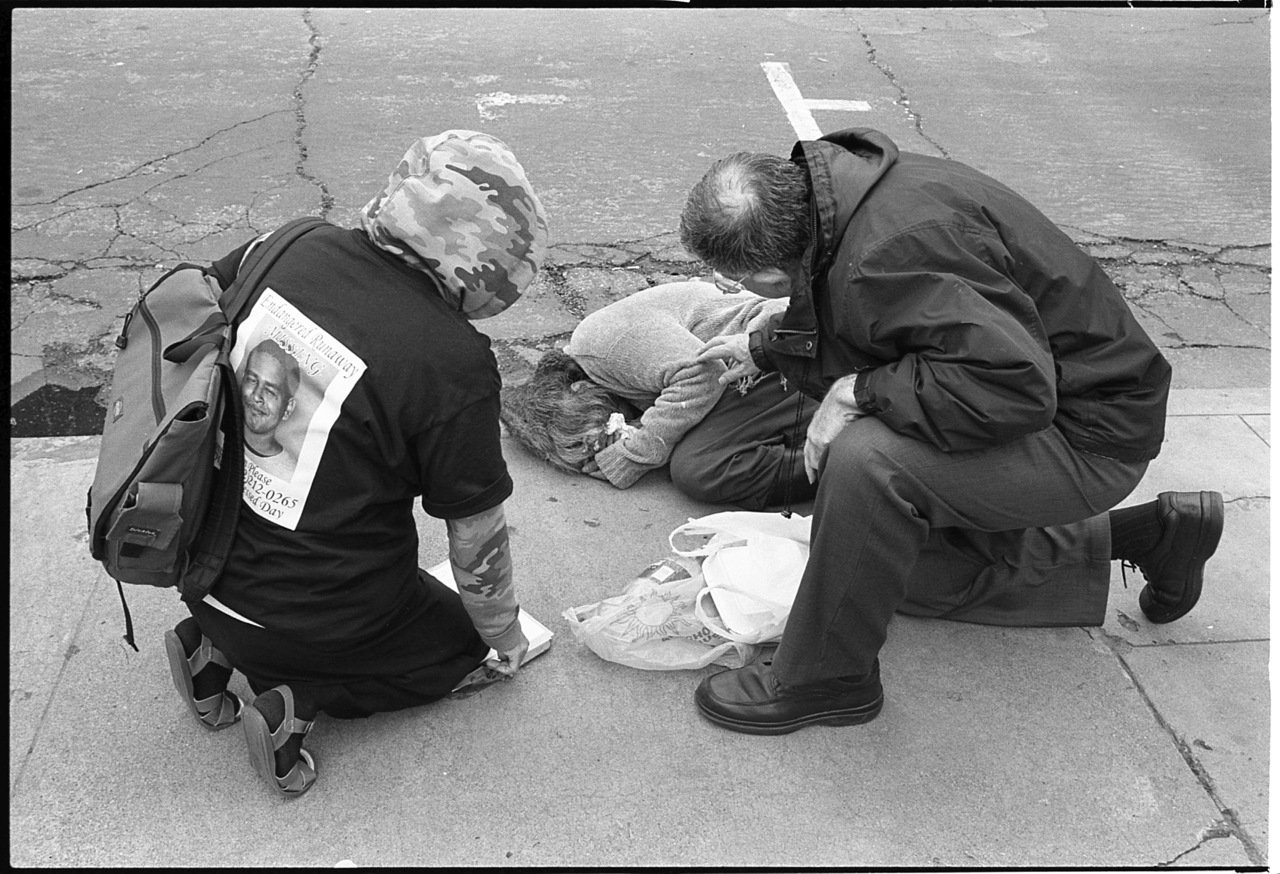
“Tending to a sick woman in front of St. Mary’s Church on Washington Street.” Taken by Brandon Getty and found via American Guide.

From Railpictures. Photographer Blair Kooistra says of this photo:
While trains detoured around the south end of the lake via Union Paciifc’s former Western Pacific, Southern Pacific work crews valiantly regained the route across the Great Salt Lake foot by foot in the summer 1986 after storms and high water washed away the railroad. While work trains dumped “armor rock” and gravel from either end to restore the roadbed, it was earth movers and maintenance workers who raised the rock fill and brought the washed-away tracks back into alignment. On the western portion of the lake between Lakeside and Strongknob, a work crew contemplates their next move.
“There’s a sweet spot on a rifle trigger where just an ounce more of pressure will fire it. There I held my finger, waiting for my shot. Twice, and then three times, the barrow paused, almost at the right angle but never quite. A fourth time, and he paced again. I grit my teeth and snorted, tense and rigid. He circled around the pen again and barely glanced at me.
Into the muddle of “dammits!” and “stand stills!” in my head, I fit a prayer for his swift death, then exhaled slowly. On his next circuit, he paused a fifth time, the spot just twelve inches from the muzzle, my eyes on it, his eyes on me. I gave the trigger that one more ounce.
In a thousandth of a second: he jerked his head as if startled by the pop; a black hole appeared on the bridge of his snout; he screamed and rammed the fence by Rusty, shoving his snout underneath the wire and lifting the entire panel.
”

Via Sunburntwest. When I have my own place, this looks like a good idea: a platform on which I may camp.

From The Hater’s Guide to the Williams-Sonoma Catalog:
Item #02-6818686 Waffle batter dispenser
Williams-Sonoma says: "Measures out uniform circles in three sizes.“
Price: $29.95
Notes from Drew: How about a spoon? How about you use a fucking spoon to dole out your waffle batter? The waffle iron itself tells you when it’s had enough batter. If you overload it because you’re a fat greedy pig, the batter spills off the side. You don’t need a dispenser. OH BUT HOW WILL I KNOW I’VE USED THE EXACT RIGHT AMOUNT OF BATTER?! Now this waffle will never fit in my grain sack!
Not necessarily in any order of preference:
Tom Wolfe (Somehow I can still say this even after reading that 700-page bowel movement called A Man in Full)
Honorable mention (because he was interviewed by Ron Hansen, not because I’ve knowingly read a word he’s written): John Irving
And a couple with the next two writers I plan to dive into: Barry Hannah and Raymond Carver.
“Unity, after all, is what God has given us through Christ’s death and resurrection. For in that death and resurrection we have been made part of God’s salvation for the world so that the world may know it has been freed from the powers that would compel us to kill one another in the name of false loyalties.”
“This is not written by a connoisseur of bourbon. Ninety-nine percent of bourbon drinkers know more about bourbon than I do. It is about the aesthetic of bourbon drinking in general and in particular of knocking it back neat.
I can hardly tell one bourbon from another, unless the other is very bad. Some bad bourbons are more memorable than good ones. For example, I can recall being broke with some friends in Tennessee and deciding to have a party and being able to afford only two-fifths of a $1.75 bourbon called Two Natural, whose label showed dice coming up 5 and 2. Its taste was memorable. The psychological effect was also notable. After knocking back two or three shots over a period of half an hour, the three male drinkers looked at each other and said in a single voice: “Where are the women?”
I have not been able to locate this remarkable bourbon since.”
“The study was done on land owned by Iowa State University called the Marsden Farm. On 22 acres of it, beginning in 2003, researchers set up three plots: one replicated the typical Midwestern cycle of planting corn one year and then soybeans the next, along with its routine mix of chemicals. On another, they planted a three-year cycle that included oats; the third plot added a four-year cycle and alfalfa. The longer rotations also integrated the raising of livestock, whose manure was used as fertilizer.
The results were stunning: The longer rotations produced better yields of both corn and soy, reduced the need for nitrogen fertilizer and herbicides by up to 88 percent, reduced the amounts of toxins in groundwater 200-fold and didn’t reduce profits by a single cent.
In short, there was only upside — and no downside at all — associated with the longer rotations. There was an increase in labor costs, but remember that profits were stable. So this is a matter of paying people for their knowledge and smart work instead of paying chemical companies for poisons. And it’s a high-stakes game; according to the Environmental Protection Agency, about five billion pounds of pesticidesare used each year in the United States.
”